
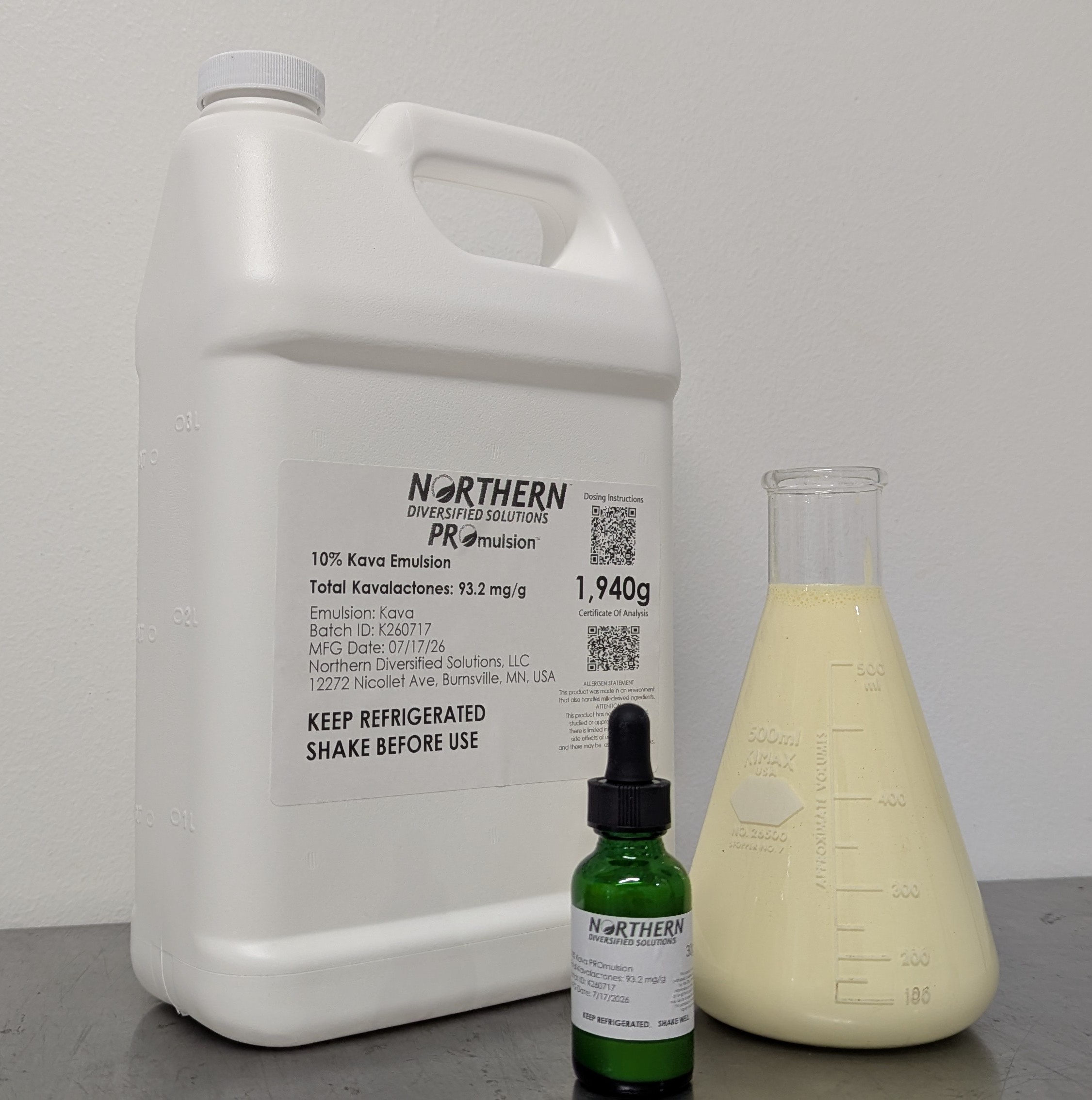
Kava’s active compounds — kavalactones — are lipophilic (oil-soluble), so they will not dissolve in water on their own. Added directly to a ready-to-drink (RTD) beverage, they cloud, separate, ring, or drop out of solution before the product reaches a shelf. A beverage-grade kava emulsion solves this by dispersing kavalactones into fine, water-compatible droplets stabilized against the classic failure modes — creaming, coalescence, flocculation, and Ostwald ripening — so the ingredient integrates cleanly and stays homogeneous through pasteurization, low-pH carbonation, and shelf life. It is the same physics our team already solved for hemp-derived cannabinoids.
Kava has moved from the kava bar to the beverage aisle. Ready-to-drink kava was the single largest segment of the kava market in 2025, and the broader category is growing at a double-digit clip on the back of the sober-curious movement and demand for functional relaxation drinks. More brands talk about kava than bring it to market, because it is hard to formulate. This guide explains why, walks through the emulsion science that makes a stable kava beverage possible, and gives formulators, co-packers, and ingredient buyers a practical framework for evaluating and sourcing a kava emulsion.
New to the category? For the market case — what kava is, how it feels compared with alcohol, and why it’s the fastest-emerging alcohol-alternative category — start with our companion piece, “Kava Beverages: The Alcohol-Alternative Category Beverage Brands Are Watching.”
What is a kava emulsion?
A kava emulsion is a food-grade liquid concentrate in which oil-soluble kavalactones are dispersed as fine droplets throughout a water-compatible carrier, stabilized by emulsifiers so the actives stay evenly distributed instead of separating out. In practice it converts an otherwise oil-loving extract into an ingredient that disperses into water-based batches — the form beverages actually need.
The key metric is droplet (particle) size. Coarse macroemulsions have larger droplets and scatter light (visible cloudiness); finer emulsions and nanoemulsions push droplet size down, which improves kinetic stability, can increase clarity, and raises the interfacial surface area available for absorption. NDS PROmulsion™ Kava, for reference, is engineered with a controlled particle size and is dispersible in water — the practical target for RTD integration.
Why kava is hard to put in a beverage
1. Kavalactones are lipophilic
The six major kavalactones (kavain, dihydrokavain, methysticin, dihydromethysticin, yangonin, desmethoxyyangonin) are largely nonpolar. Nonpolar compounds dissolve in oils, not water. Drop a raw kava extract or oleoresin into an aqueous beverage and thermodynamics takes over: the oil phase wants to minimize contact with water, so the actives coalesce, rise, and separate. This is the exact same solubility problem posed by cannabinoids (CBD, THC) in hemp beverages — which is why the emulsion toolkit developed for cannabis transfers directly to kava.
2. Emulsions fail in predictable ways
Even once you disperse the oil phase, a beverage emulsion has to survive months of storage and aggressive processing. The physical failure modes are well characterized:
| Failure mode | What goes wrong in the can |
| Creaming | Density mismatch lets oil droplets migrate upward, forming a concentrated layer or visible ring at the top. |
| Coalescence | Droplets merge into larger droplets, accelerating separation and dose inconsistency. |
| Flocculation | Droplets clump together, changing appearance and destabilizing the system. |
| Ostwald ripening | Molecules diffuse from small droplets to large ones through the water phase, so droplets grow over time. |
| Sedimentation / ringing | Actives drop out or deposit on packaging — the “it clouded and separated” complaint. |
3. The flavor problem
Dispersion gets kava into the can; flavor is what brings people back to it. Kava carries an earthy, bitter, numbing profile that fights whatever flavor system you build around it. A kava ingredient engineered to tame that earthy character means your flavor house does less, and your product wins on the shelf.
What makes a beverage-grade kava emulsion work
A production-ready kava emulsion takes more than kava plus an emulsifier. Four levers do the real work:
- Emulsifier system and HLB balance. The right hydrophilic–lipophilic balance (HLB) forms a robust interfacial film around each droplet, limiting coalescence, flocculation, and ripening. Beverage systems commonly use food-grade emulsifiers, modified starches, and gum acacia.
- Controlled droplet size. High-shear or ultrasonic processing drives droplets small and uniform. Smaller, tighter distributions cream more slowly and resist ripening — the difference between a 6-month shelf life and a 6-week one.
- Weighting agents and ripening inhibitors. Closing the density gap between the oil droplets and water slows creaming; ripening inhibitors in the oil phase blunt Ostwald ripening. These are the stabilizers that keep a system kinetically stable long enough to matter.
- Process and matrix compatibility. The emulsion has to hold through the beverage’s real conditions: thermal pasteurization, low-pH (acidic) matrices, and CO₂ carbonation. An emulsion validated only in still, neutral water will not predict how it behaves in a carbonated, pH-3.5 sparkling drink.
Formulator’s rule of thumb: validate stability in your actual matrix — target pH, carbonation level, sweetener system, and thermal process — not in a beaker of tap water. Most “stable” emulsions fail at the intersection of low pH and carbonation, so test that corner first.
The hemp-beverage parallel: a solved problem
Cannabinoids and kavalactones are both lipophilic actives that need to behave in water, and the nanoemulsion and emulsion technology built for CBD and THC RTDs — droplet-size control, HLB-tuned emulsifier systems, ripening inhibitors, matrix validation — maps onto kava. We apply the same operators, equipment, and documentation to kavalactones — the approach we detail in our hemp emulsion beverage guide. For brands, that means kava does not require inventing a new supply chain; it requires a partner who already understands lipophilic-active dispersion at beverage scale. NDS runs both — our kava PROmulsion™ is built on the same emulsion science behind our hemp line.
The market: why formulators are getting kava briefs now
The commercial pull behind these formulation questions is real and quantified:
- RTD kava was the largest market segment in 2025, valued at roughly $680 million and holding about a third of the global kava market (Dataintelo).
- The kava root extract market was valued near $1.87 billion in 2025, with forecasts projecting growth to $2.17 billion in 2026 and continued double-digit CAGR through the early 2030s (Fortune Business Insights).
- U.S. kava bars have multiplied over the past two decades — hundreds now operate nationwide — seeding mainstream familiarity that RTD brands are now converting into retail demand.
- The sober-curious and functional-beverage movements are driving demand for non-alcoholic relaxation cues, the occasion kava fits.
The clearest signal that stability is the real battleground came in July 2026, when Vibes Beverages launched a kava RTD whose headline innovation was a proprietary emulsion-and-fiber system built to stabilize kavalactones and extend shelf life past a year, more than double the category norm. For R&D and NPD teams, the pattern is clear: kava is following the hemp-beverage adoption curve, and the brands that bring a stable, good-tasting product to market first will lead the category.
How to evaluate a kava emulsion supplier
Whether you are a co-packer, a formulator, or an ingredient buyer, use this checklist to separate a beverage-ready partner from a repackager:
- Beverage-specific stability data. Ask for stability under your conditions — low-pH, carbonation, and refrigerated/ambient shelf life — not merely “it mixes in water.”
- Standardized, verified active content. A defined mg/g kavalactone loading and a Certificate of Analysis (COA) on every lot for dose accuracy and traceability.
- Clean sourcing and extraction. Noble-cultivar root, root-only material, and CO₂ (or aqueous) extraction rather than solvents.
- Chain-of-custody traceability. Documented custody from root intake to finished emulsion, under food-grade GMP.
- Particle-size and appearance spec. A controlled particle size and defined appearance so batches behave predictably in your line.
- Flavor workability. Evidence the supplier has addressed kava’s earthy, bitter profile — it directly affects your masking cost.
- Technical support. Access to formulators who understand both the ingredient science and the beverage market and can support your program from concept through shelf life.
Frequently asked questions
Is kava water soluble? Not on its own. Kavalactones are lipophilic (oil-soluble), so raw kava extract will not dissolve in water and tends to cloud or separate. An emulsion disperses kavalactones into fine, water-compatible droplets, making them dispersible in water-based beverages.
Why does kava separate or cloud in a beverage? Because the oil-soluble actives are denser or lighter than water and want to minimize contact with it. Without an emulsion, they cream, coalesce, floc, or drop out through Ostwald ripening — the visible clouding, ringing, and separation brands complain about.
What is the difference between a kava emulsion and a kava nanoemulsion? Both disperse oil-soluble kavalactones in water using emulsifiers. A nanoemulsion pushes droplet size to roughly 100 nm or below, which can improve clarity, kinetic stability, and absorption surface area. “Emulsion” is the broader category; droplet size is the differentiator.
How much kava emulsion do I add to a beverage? It depends on the emulsion’s standardized kavalactone loading and your target dose per serving. Set that per-serving target with your regulatory and sensory teams, then validate in your finished matrix. Ask your supplier for the loading (mg/g) and a COA so you can calculate inclusion precisely.
See it perform in your own formula
NDS builds high-performing kava emulsions — refined, emulsified, tested, and verified in-house under food-grade GMP in Minnesota — with a COA on every lot and full chain-of-custody traceability. Request full specs and a sample, or start a formulation project, and put PROmulsion™ to the test where kava usually fails: in your actual matrix, at your target pH and carbonation.
Contact: (952) 905-8877 · contact@northerndiversified.com · northerndiversified.com/kava